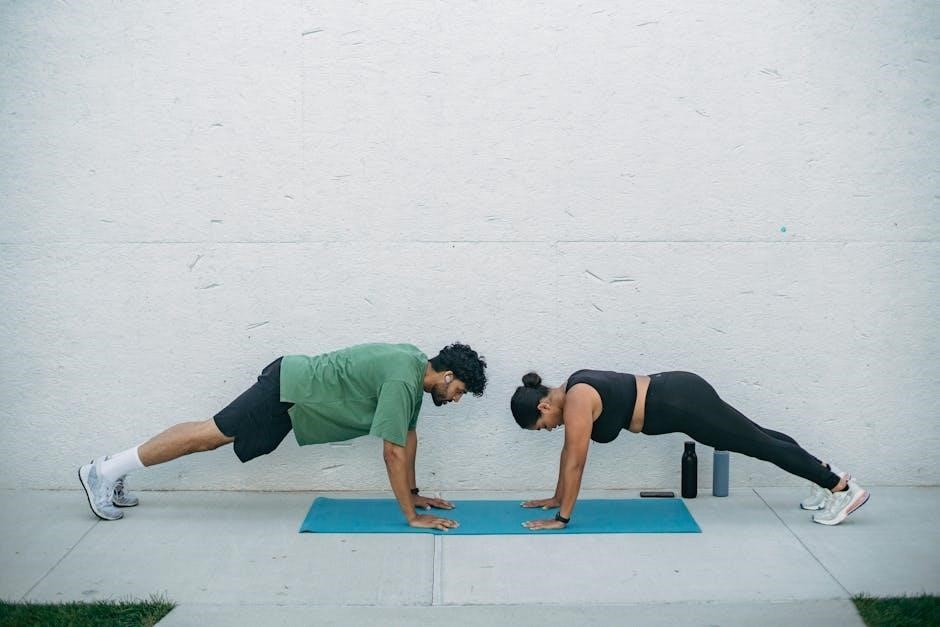
Embark on a transformative fitness journey! This comprehensive 12-week plan utilizes only your bodyweight, offering accessible strength and conditioning for all levels.
What is a Bodyweight Workout?
Bodyweight workouts leverage your own weight as resistance, eliminating the need for expensive gym equipment or dumbbells. This makes them incredibly accessible, allowing you to exercise virtually anywhere – at home, in a park, or while traveling. These routines focus on fundamental movements like squats, push-ups, lunges, and planks, building strength, endurance, and flexibility.
They are perfect for beginners, as exercises can be easily modified to suit different fitness levels. As you progress, variations and increased repetitions challenge your muscles, promoting continuous improvement. This plan utilizes progressive overload, gradually increasing difficulty over the 12 weeks.
Benefits of Bodyweight Training
Bodyweight training offers a multitude of advantages. It enhances muscular strength and endurance without external weights, improving functional fitness for everyday activities. Increased stability and balance are key benefits, potentially reducing the risk of falls and injuries. These workouts boost cardiovascular health and can contribute to weight management by burning calories.
Furthermore, bodyweight exercises improve body awareness and core strength, essential for proper posture and movement. This plan is designed to make you feel stronger and more capable, promoting overall well-being and a healthier lifestyle.
Who is This Plan For?
This 12-week bodyweight plan is ideal for beginners taking their first steps into fitness, or those returning after a break. It’s also perfect for individuals seeking a convenient, equipment-free workout solution. If you struggle with getting up from the floor or carrying groceries, this plan can help rebuild strength.
Whether you’re new to calisthenics or simply prefer a minimalist approach, this program adapts to your fitness level. It’s designed to build a solid foundation, progressively increasing intensity for noticeable results.

Phase 1: Foundation Building (Weeks 1-4)
Establish a strong base! This initial phase focuses on mastering fundamental movements and building endurance with a 3-day-per-week schedule.
Warm-up Routine (Phase 1)
Prepare your body for success! Begin each workout with a 5-10 minute dynamic warm-up. Include exercises like arm circles, leg swings, torso twists, and high knees. These movements increase blood flow to your muscles and improve joint mobility, reducing the risk of injury. Incorporate light cardio, such as jumping jacks or marching in place, to elevate your heart rate. A proper warm-up is crucial for optimizing performance and ensuring a safe and effective workout experience. Don’t skip this vital step – it sets the stage for a productive session!
Workout Schedule (Phase 1) ⎼ 3 Days/Week
Establish a consistent routine! Phase 1 focuses on building a foundation with three workouts per week. Allow for rest days between sessions to facilitate muscle recovery. Day 1 is dedicated to full-body strength, targeting all major muscle groups. Day 2 combines cardio exercises like jumping jacks with core strengthening movements. Finally, Day 3 emphasizes lower body strength and endurance. This schedule provides a balanced approach, gradually increasing your fitness level. Remember to listen to your body and adjust the intensity as needed.
Day 1: Full Body Strength
Focus on compound movements! This workout targets multiple muscle groups simultaneously for maximum efficiency. Begin with a thorough warm-up, preparing your muscles for exertion. Incorporate bodyweight squats to strengthen legs and glutes, followed by push-ups (modified if needed) for chest, shoulders, and triceps. Include exercises like lunges and planks to enhance overall strength and stability. Perform 3 sets of 10-12 repetitions for each exercise, maintaining proper form throughout. Cool down with stretching to improve flexibility and reduce muscle soreness.
Day 2: Cardio & Core
Elevate your heart rate and strengthen your midsection! Start with a dynamic warm-up, preparing your body for cardiovascular exercise. Incorporate jumping jacks for a full-body cardio burst, followed by high knees and butt kicks to further increase intensity. Focus on core exercises like planks, crunches, and Russian twists to build abdominal strength and stability. Perform each exercise for 30-60 seconds, completing 3 sets with short rest periods. Remember to maintain proper form to prevent injuries and maximize results. Cool down with static stretches.
Day 3: Lower Body Focus
Sculpt and strengthen your legs and glutes! Begin with a dynamic warm-up targeting lower body muscles. Perform bodyweight squats, focusing on proper form and depth. Incorporate lunges – forward, reverse, and lateral – to challenge different muscle groups. Add calf raises to strengthen your lower legs. For an added challenge, try single-leg squats (assisted if needed). Complete 3 sets of 10-15 repetitions for each exercise, with short rest intervals. Remember to engage your core throughout the workout for stability and balance. Finish with static stretches.
Key Exercises (Phase 1)

Build a solid foundation with these essential movements! Phase 1 focuses on mastering fundamental exercises. Bodyweight Squats are crucial for lower body strength and mobility. Push-ups (Beginner Modifications) – wall push-ups or knee push-ups – build upper body strength. Jumping Jacks provide a fantastic cardio element and warm-up. Focus on controlled movements and proper form over speed. These exercises are designed to build a base level of fitness, preparing you for more challenging workouts in later phases. Prioritize technique to prevent injuries and maximize results.
Bodyweight Squats
Master the foundational Bodyweight Squat! Stand with feet shoulder-width apart, toes slightly outward. Lower your hips as if sitting in a chair, keeping your back straight and core engaged. Ensure your knees track over your toes and don’t extend past them. Aim for a depth where your thighs are parallel to the ground, if possible. Push through your heels to return to the starting position. This exercise strengthens quads, hamstrings, and glutes. Focus on controlled movements and maintaining proper form throughout each repetition for optimal results.
Push-ups (Beginner Modifications)
Build upper body strength with Push-ups! Start in a plank position with hands shoulder-width apart. Lower your chest towards the ground, keeping your body in a straight line. Push back up to the starting position. If standard push-ups are too challenging, modify by performing them on your knees. This reduces the load while still engaging the same muscle groups. Alternatively, incline push-ups against a wall or elevated surface are excellent for beginners. Prioritize proper form – a straight back and controlled movements – over the number of repetitions.
Jumping Jacks
Elevate your heart rate with Jumping Jacks! Begin standing with feet together and arms at your sides. Simultaneously jump your feet out to the sides and raise your arms overhead. Return to the starting position by jumping back in and lowering your arms. This classic cardio exercise is fantastic for warming up and improving cardiovascular health. Focus on maintaining a steady rhythm and controlled movements. Modify by stepping one foot out at a time if jumping is difficult. Aim for consistent repetitions to build endurance and burn calories.

Phase 2: Strength & Endurance (Weeks 5-8)
Progress to increased intensity! This phase introduces a 4-day schedule, focusing on building both muscular strength and cardiovascular endurance through varied exercises.
Warm-up Routine (Phase 2)
Prepare your body for enhanced performance! This phase’s warm-up should last approximately 5-10 minutes. Begin with 2 minutes of light cardio, such as jogging in place or jumping jacks, to elevate your heart rate. Follow this with dynamic stretching, focusing on movements that mimic the exercises in your workout. Include arm circles, leg swings, torso twists, and high knees.
Prioritize movements that improve range of motion and prepare your muscles for exertion. Don’t forget to include wrist and ankle rotations. A proper warm-up minimizes injury risk and maximizes workout effectiveness, setting the stage for strength and endurance gains.
Workout Schedule (Phase 2) ⏤ 4 Days/Week
Increase the intensity with a four-day split! This phase demands greater commitment. Day 1 focuses on Upper Body Strength, building chest, shoulders, and arms. Day 2 targets Lower Body Strength, emphasizing legs and glutes. Day 3 is dedicated to Core & Stability, strengthening your midsection for improved posture and balance.
Finally, Day 4 incorporates a Full Body Circuit, combining exercises for a comprehensive workout. Allow for rest days between workouts to facilitate muscle recovery and prevent overtraining. Consistency is key to achieving optimal results during this strength and endurance phase.
Day 1: Upper Body Strength
Sculpt and strengthen your upper body! Begin with a dynamic warm-up, preparing muscles for exertion. Focus on exercises like incline push-ups, progressively challenging your chest and triceps. Incorporate variations to target different muscle fibers. Include exercises for shoulders, such as pike push-ups or handstand holds (against a wall for safety).
Don’t neglect your back – perform bodyweight rows using a sturdy table or low bar. Aim for 3-4 sets of 8-12 repetitions for each exercise, prioritizing proper form over quantity. Cool down with static stretches.
Day 2: Lower Body Strength
Build powerful legs and a strong core! Start with a thorough warm-up, focusing on dynamic stretches for your hips and legs. The core of this workout revolves around lunges – forward, reverse, and lateral – to target quads, hamstrings, and glutes. Incorporate bodyweight squats, progressing to pistol squats (assisted if needed) as strength increases.
Calf raises are essential for lower leg definition. Perform 3-4 sets of 10-15 repetitions for each exercise, maintaining proper form. Finish with static stretches to improve flexibility and prevent soreness.
Day 3: Core & Stability
Strengthen your foundation! This session focuses on building a robust core for improved posture and balance. Begin with plank variations – standard, side, and forearm planks – holding each for 30-60 seconds. Incorporate exercises like Russian twists, leg raises, and bicycle crunches to target different abdominal muscles.
Bird-dogs and glute bridges enhance stability and coordination. Perform 3-4 sets of 15-20 repetitions for each exercise, concentrating on controlled movements. Remember to engage your core throughout the entire workout for maximum effectiveness.
Day 4: Full Body Circuit
Maximize calorie burn and endurance! This dynamic circuit combines strength and cardio for a challenging, full-body workout. Perform each exercise for 45 seconds, followed by 15 seconds of rest. Cycle through exercises like burpees, mountain climbers, squat jumps, and push-ups.
Include lunges, plank jacks, and high knees to elevate your heart rate. Complete 3-4 rounds of the circuit, minimizing rest between rounds. Focus on maintaining proper form throughout to prevent injuries and optimize results. This circuit builds both strength and cardiovascular fitness.
Key Exercises (Phase 2)
Elevate your training with progressive exercises! Phase 2 introduces increased intensity. Incline Push-ups build upper body strength with a modified challenge. Lunges target legs and glutes, improving lower body power and balance. Plank Variations – side planks and plank jacks – enhance core stability and endurance.
Focus on controlled movements and proper form. Incorporate exercises like supermans and bird dogs for back strength. Remember to engage your core throughout each exercise; These key movements form the foundation for continued progress.
Incline Push-ups
Incline Push-ups are a fantastic progression from standard push-ups! Performing these against an elevated surface – a bench, step, or sturdy box – reduces the difficulty, making them ideal for building strength. This variation emphasizes the lower pectoral muscles and allows for greater range of motion.
Maintain a straight line from head to heels, engaging your core and squeezing your glutes. Lower your chest towards the incline, then push back up. Aim for 3 sets of 8-12 repetitions, focusing on controlled movements.
Lunges
Lunges are a powerful exercise for building lower body strength and improving balance! Step forward with one leg, lowering your body until both knees are bent at 90-degree angles. Ensure your front knee stays aligned over your ankle, and your back knee doesn’t touch the ground.
Engage your core and glutes throughout the movement. Push off your front foot to return to the starting position. Perform 3 sets of 10-12 repetitions per leg, alternating sides. Focus on controlled form to maximize effectiveness and prevent injury.
Plank Variations
Plank variations elevate core stability and strength! Begin with a standard plank, maintaining a straight line from head to heels. Progress to side planks, engaging obliques by lifting one arm towards the ceiling. Add dynamic movements like plank jacks, jumping your feet in and out.
Try forearm planks for a different challenge, or incorporate plank taps, alternating touching shoulders. Hold each variation for 30-60 seconds, completing 3 sets. Proper form is crucial – keep your core engaged and avoid sagging hips.

Phase 3: Advanced Strength & Conditioning (Weeks 9-12)
Unleash your peak potential! This final phase introduces high-intensity interval training (HIIT) and advanced exercises for maximum strength gains and conditioning.
Warm-up Routine (Phase 3)
Prepare your body for intense workouts with this dynamic warm-up. Begin with 5 minutes of light cardio, such as jogging in place or high knees, to elevate your heart rate. Follow this with dynamic stretches, including arm circles, leg swings, torso twists, and walking lunges – perform each for 30 seconds.
Don’t forget to incorporate core activation exercises like bird-dogs and planks (hold for 30 seconds) to stabilize your spine. This comprehensive warm-up enhances flexibility, improves blood flow to muscles, and reduces the risk of injury during the challenging Phase 3 exercises. Prioritize proper form over speed.
Workout Schedule (Phase 3) ⎼ 5 Days/Week
Maximize your gains with this high-frequency schedule. Monday: Upper Body Power – focus on explosive movements. Tuesday: Lower Body Power – build strength and explosiveness in your legs. Wednesday: Core & Functional Movement – enhance stability and coordination. Thursday: Full Body HIIT – intense intervals for calorie burn and endurance.
Friday: Active Recovery/Yoga – promote recovery and flexibility. Each workout should last 45-60 minutes, including warm-up and cool-down. Listen to your body and adjust the intensity as needed. Consistency is key to achieving optimal results during this advanced phase.
Day 1: Upper Body Power
Focus on explosive strength and muscle endurance. Begin with a dynamic warm-up, including arm circles and shoulder rotations. Perform 4 sets of decline push-ups (8-12 reps), followed by plyometric push-ups (6-10 reps) – modify by stepping back instead of jumping if needed. Include diamond push-ups (8-12 reps) for tricep focus.
Finish with bodyweight rows using a sturdy table or bar (10-15 reps). Rest 60-90 seconds between sets. Prioritize controlled movements and proper form to maximize effectiveness and prevent injury. Cool down with static stretches targeting chest, shoulders, and triceps.
Day 2: Lower Body Power

Develop explosive leg strength and power. Start with a dynamic warm-up, including leg swings and hip circles. Execute 4 sets of pistol squats (assisted if necessary, 6-10 reps per leg), followed by jump squats (10-15 reps). Incorporate Bulgarian split squats (8-12 reps per leg) for unilateral strength.
Conclude with walking lunges (10-12 reps per leg). Maintain a controlled descent and explosive upward drive. Rest for 60-90 seconds between sets. Prioritize form to avoid knee strain. Finish with static stretches targeting quads, hamstrings, and glutes.
Day 3: Core & Functional Movement
Enhance stability and everyday movement patterns. Begin with a focused warm-up, activating core muscles. Perform 3 sets of plank variations – standard plank (30-60 seconds), side plank (30-60 seconds per side), and plank with shoulder taps (10-15 reps per side).
Add Russian twists (15-20 reps per side) and bird-dogs (10-12 reps per side). Finish with mountain climbers (20-30 reps) and glute bridges (15-20 reps). Focus on controlled movements and proper form. Rest 60 seconds between sets. Cool down with core stretches.
Day 4: Full Body HIIT
Maximize calorie burn and improve cardiovascular fitness! This High-Intensity Interval Training (HIIT) session combines bursts of effort with short recovery periods. Perform each exercise for 45 seconds, followed by 15 seconds of rest.
Complete 3-4 rounds of burpees, jumping jacks, high knees, mountain climbers, and squat jumps. Focus on maintaining proper form throughout. A dynamic warm-up is crucial before starting. Cool down with static stretches, holding each stretch for 30 seconds. Remember to listen to your body and adjust intensity as needed.
Day 5: Active Recovery/Yoga
Prioritize recovery and flexibility! This day focuses on gentle movement to reduce muscle soreness and improve joint mobility. Choose a restorative yoga flow or engage in light activities like walking, swimming, or cycling at a low intensity.
Focus on deep breathing and mindful movement. Incorporate stretches targeting major muscle groups. Active recovery aids in flushing out metabolic waste and prepares your body for the next training cycle. Listen to your body and avoid pushing yourself too hard; the goal is rejuvenation.
Key Exercises (Phase 3)
Challenge yourself with advanced movements! Decline Push-ups increase upper body engagement, targeting the chest and triceps with greater intensity. Pistol Squats (Assisted) build incredible lower body strength and balance – use support if needed.
Burpees deliver a full-body blast, combining strength and cardio for maximum calorie burn. Master proper form to prevent injury. These exercises demand control and power, pushing your limits and accelerating your fitness gains. Focus on quality over quantity, and progressively increase difficulty.
Decline Push-ups
Elevate your push-up game! Decline push-ups are a fantastic progression, increasing the challenge to your upper chest and shoulders. By elevating your feet on a stable surface, you shift more weight onto these muscle groups.
Maintain a straight line from head to heels, engaging your core throughout the movement. Lower your chest towards the floor with control, then powerfully push back up. This variation builds significant upper body strength and definition. Remember proper form is crucial to avoid strain.
Pistol Squats (Assisted)
Master single-leg strength! Pistol squats are incredibly challenging, requiring significant balance and lower body power. If a full pistol squat is beyond your current ability, don’t worry! Utilize assistance – hold onto a stable object like a doorframe or pole.
Slowly extend one leg forward while lowering into a squat on the other. Focus on maintaining a straight back and controlled descent. This builds strength, stability, and improves functional movement patterns. Progress gradually, reducing assistance as you improve.
Burpees
The ultimate full-body blast! Burpees are a powerhouse exercise combining strength, cardio, and coordination. Begin in a standing position, drop into a squat, kick your feet back into a plank, perform a push-up (optional), return to the squat, and explosively jump upwards.
This dynamic movement elevates your heart rate and challenges multiple muscle groups simultaneously. Modify by stepping back instead of jumping, or omitting the push-up. Burpees are fantastic for building endurance and burning calories efficiently.

Important Considerations
Success hinges on consistency and mindful practice! Prioritize proper form, nourish your body with a balanced diet, and allow adequate rest for optimal recovery.
Proper Form and Technique
Maintaining correct form is paramount throughout this 12-week bodyweight program. Prioritize quality over quantity; executing each exercise with precision minimizes injury risk and maximizes effectiveness. Focus on controlled movements, engaging the correct muscle groups, and maintaining a neutral spine.
If you’re unsure about proper technique, seek guidance from online resources or a fitness professional. Push-ups, for example, require a straight line from head to heels. Incorrect form can negate benefits and lead to strain. Listen to your body, and don’t push through pain. Gradual progression is key!
Nutrition for Optimal Results
Fueling your body correctly is crucial alongside this 12-week bodyweight plan. Prioritize a balanced diet rich in lean proteins, complex carbohydrates, and healthy fats. Adequate protein supports muscle repair and growth, while carbohydrates provide energy for workouts.
Hydration is also key – drink plenty of water throughout the day. Consider timing your meals to optimize performance and recovery. Focus on whole, unprocessed foods and limit sugary drinks and excessive saturated fats. Proper nutrition amplifies the benefits of your training, leading to superior results!

Rest and Recovery
Prioritizing rest is as vital as the workouts themselves! This 12-week bodyweight plan incorporates scheduled rest days, but listen to your body. Adequate sleep (7-9 hours) is non-negotiable for muscle recovery and overall health.
Active recovery, like light walking or yoga, can also aid in reducing muscle soreness. Don’t push through pain; allow your body to heal. Ignoring rest can lead to injury and hinder progress. Remember, recovery is when your body adapts and gets stronger!